
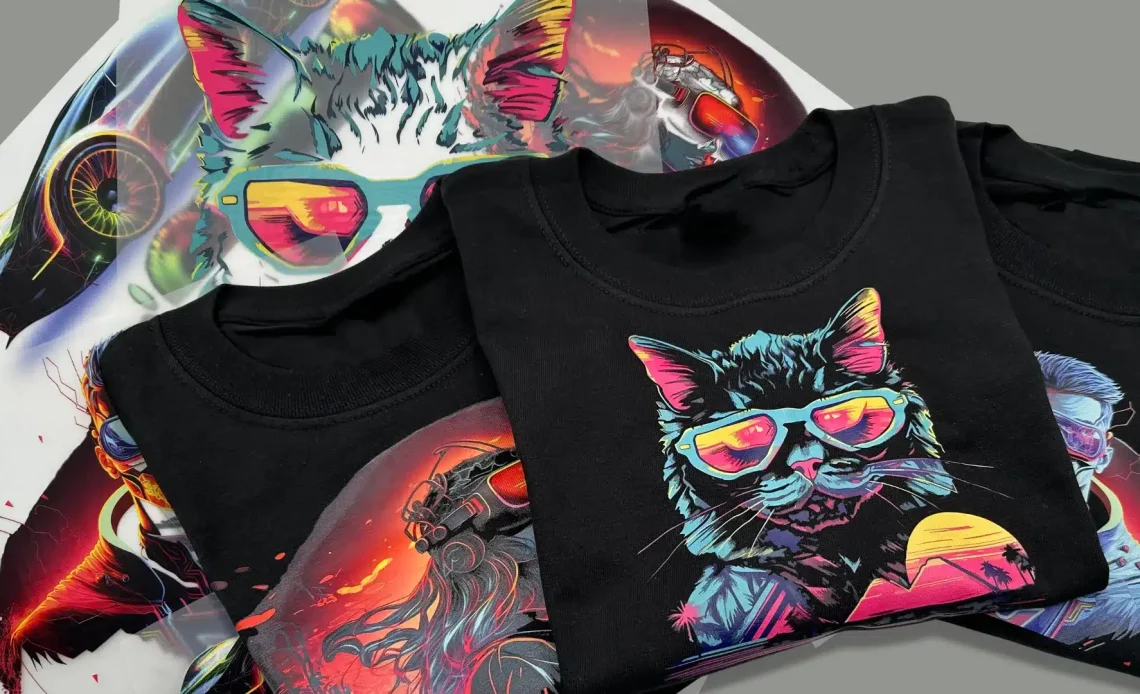
When New Jersey residents search for custom apparel — a team jersey, a business polo, an event shirt — two production methods come up most often: embroidery and DTF (Direct to Film) transfers. They’re both legitimate, both widely available in NJ, and both produce finished custom garments. But they’re suited to different things, and choosing the wrong method for your order costs money and produces results you didn’t want.
Here’s a practical comparison for NJ buyers deciding between the two.
What Embroidery Is Good For
Embroidery stitches thread directly into the fabric, creating a raised, textured design that’s immediately recognizable as premium. It works best for:
Simple, bold designs. Embroidery renders solid shapes and clean lettering well. A company logo with a few distinct elements, a monogram, a bold team name — these translate cleanly to thread. Designs with fine detail, gradients, or photographic elements don’t embroider cleanly; the thread count can’t replicate that level of detail.
Professional and corporate applications. Embroidered polo shirts and dress shirts carry an implied quality signal that’s appropriate for client-facing business apparel. The texture reads as investment in presentation.
Durable single-design applications. Embroidery on a single garment style (a polo, a jacket, a cap) that will be reordered regularly in consistent quantities is a cost-effective long-term approach.
Limitations: Setup costs are significant. A digitization fee — converting your logo into a stitch pattern — typically runs $25-$75 per design. That setup cost amortizes over large orders but makes small runs expensive. Most NJ embroidery shops have minimums of 12-24 pieces. Complex, colorful designs are either impossible or prohibitively expensive.
What DTF Transfers Do Differently
Direct to Film printing produces a full-color transfer film that’s heat-pressed onto a garment. It handles everything embroidery can’t:
Full color, no per-color charge. A six-color logo with gradients costs the same per transfer as a simple two-color design. The complexity of the artwork doesn’t affect the transfer cost — only the size does.
No setup fee. There’s no digitization equivalent in DTF. Submit a print-ready PNG and the transfer is produced directly. That makes small-batch orders and one-off custom pieces economically viable.
Accurate reproduction of complex artwork. Photography, illustrations, gradients, fine detail — DTF handles all of it. The transfer reproduces exactly what’s in the file.
No minimums. DTF Jersey ships from New Jersey with no minimum order quantity. A single jersey for a graduation gift and an order of 60 event shirts go through the same process at the same per-transfer rate.
For NJ buyers searching for custom embroidery near me NJ, it’s worth asking whether embroidery is actually required — or whether it just sounds like the expected production method for custom apparel. Many buyers who investigate both options discover DTF delivers comparable visual results for their specific application at a lower per-unit cost and faster timeline.
When Each Method Makes Sense for NJ Orders
Choose embroidery when: – The design is simple (3-5 colors, no gradients, no fine detail) – The application is business formal (corporate polos, dress shirts, outerwear) – The quantity is large enough to amortize setup costs (50+ pieces minimum) – The garment material is appropriate (woven fabrics embroider better than performance knits)
Choose DTF when: – The design has multiple colors, gradients, or photographic elements – You need a small quantity (1-30 pieces) – You need fast turnaround — NJ DTF suppliers ship same-day, with next-day delivery for NJ addresses – The garments are athletic wear, polyester, or performance fabric – You want to test a design before committing to a full run
A note on jerseys specifically. Athletic jerseys — polyester mesh, performance knit, moisture-wicking fabric — are not ideal candidates for embroidery. The fabric doesn’t hold thread well, and the weight of embroidery on lightweight athletic material affects how the garment drapes. DTF transfers bond to polyester at appropriate temperatures and flex with the fabric. For jersey applications, DTF is almost always the right call.
The NJ Market for Custom Apparel
New Jersey has a dense concentration of sports leagues, school programs, corporate offices, and community organizations that all regularly need custom apparel. The options for meeting that need have expanded in the past few years as DTF technology has become more accessible.
Local embroidery shops are operating throughout NJ, with concentrations in the suburban commercial corridors around Newark, Trenton, Cherry Hill, and along the shore. Most focus on the corporate and promotional segment — business polos, branded outerwear, promotional caps.
DTF suppliers serving NJ customers include both local operators and regional shippers. DTF Jersey operates from New Jersey and ships same-day on qualifying orders, with NJ customers typically receiving transfers the next business day. Their New Jersey service page covers regional ordering specifics and is worth reviewing before placing a first order.
Realistic Cost Comparison for NJ Orders
For a 20-jersey order with a four-color logo:
Embroidery route: – Digitization fee: $40-$75 (one-time per design) – Per-piece embroidery: $6-$12 depending on stitch count – Blank garments: $8-$15 per piece – Total per jersey at 20 pieces: $18-$35+ including setup amortization
DTF route: – Transfer cost: $0.21-$0.50 per piece (no setup fee) – Pressing: $2-$4 per piece if using a decorator – Blank garments: $4-$12 depending on style – Total per jersey at 20 pieces: $8-$18
The cost difference is largest at small quantities. At 200 pieces, embroidery’s setup cost becomes negligible and the methods become more competitive on total cost. At 20 pieces, DTF is typically 30-50% less expensive per finished garment.
Making the Right Call
Neither method is universally better. The right choice depends on the garment type, design complexity, order size, and timeline. For athletic jerseys with complex designs in small quantities — the most common custom apparel need for NJ sports teams, school programs, and event organizers — DTF is the right answer most of the time.
For formal business apparel with simple logos in consistent large quantities, embroidery is still the appropriate choice.
Knowing the difference before you order saves the frustration of paying for a production method that wasn’t right for the application.
