

Cast AI was not supposed to be a Miami story. When the company started in 2020 with 25 employees and a narrow mission to help engineering teams stop burning cloud budget, the city was still in the middle of pitching itself as a serious tech destination. Most of the credibility was borrowed — transplants from New York and San Francisco, investor interest drawn by tax advantages and good weather, plenty of announcements without the track record to back them up.
Six years later, Cast AI has more than 350 employees, a valuation north of $1 billion, and a product that enterprises are racing to buy. In January 2026, the company closed a strategic investment from Pacific Alliance Ventures, the U.S.-based venture arm of South Korea’s Shinsegae Group, a conglomerate with more than $50 billion in annual revenue. The new product behind that investment, OMNI Compute, lets companies run AI workloads across multiple cloud providers and regions without rewriting their code. Samsung came in as an early customer. Oracle made excess GPU capacity available through the platform. Cast AI’s president and co-founder Laurent Gil described closing the company’s largest deals ever on a product that was less than a month old.
That trajectory matters beyond one company’s cap table. Cast AI built from seed to unicorn inside Miami. It did not raise here and then move. It hired here, scaled here, and is expanding here. That is a different kind of story than the relocation narrative Miami was telling four years ago.
The Capital That Changed the Conversation
The Miami metro raised between $3.5 billion and $4 billion in venture capital in 2025, the strongest year on record for the region. Q4 alone saw $612 million across 109 deals. The Global Startup Ecosystem Report now ranks Miami 16th globally, with a $95 billion ecosystem valuation, and the city ranks first in the U.S. for tech job growth and migration. Those figures are cumulative — each year of compounding investment produces the experienced operators and second-time founders who make the next generation of companies more likely to succeed.
The 2025 infrastructure layer was particularly significant. Cast AI tackled cloud cost and GPU scarcity at enterprise scale. Agentuity raised capital to build an AI-first cloud purpose-built for autonomous agents. Exowatt focused on the data-center power problem that sits underneath all of it. These are not consumer apps or feature wrappers on top of existing models. They are picks-and-shovels businesses for the AI era, and they are being built in Miami by people who chose to stay.
What the Ecosystem Actually Looks Like Now
As artificial intelligence becomes increasingly important to modern businesses, managers need to understand how AI can be applied to improve operations, support strategic decisions, and create new opportunities. Professionals looking to strengthen these skills can explore an ai for managers program to develop practical knowledge of artificial intelligence, business applications, and responsible technology adoption.
The depth across verticals is worth paying attention to. FirmPilot automates client acquisition for law firms using generative AI, turning competitive data and search patterns into marketing campaigns that the firm’s own team could not produce manually. Theator builds surgical intelligence tools that convert operating room video into structured clinical data, giving health systems a way to analyze outcomes and improve protocols at scale. Mytaverse runs photorealistic 3D digital twin environments for enterprise meetings and training, a product that sits at the intersection of AI and spatial computing.
Each of those companies addresses a specific professional environment with specific operational pain. That is the pattern of a mature ecosystem producing grounded, sellable software, not a scene generating demo-day buzz.
Miami’s structural advantages compound this. The city’s bilingual workforce and its geographic position between North America and Latin America give startups a natural expansion path that companies in other tech hubs have to manufacture from scratch. Founders with teams in Miami regularly close enterprise customers in Brazil, Mexico, Colombia, and Chile without opening a separate office. Latin American venture capital increasingly treats Miami as a natural co-investment market. The cultural fluency runs in both directions, and for AI companies targeting financial services, insurance, retail, and healthcare across the Americas, that matters.
The conference calendar reflects a scene that has grown past the early-adopter phase. eMerge Americas, Miami Tech Summit, the Miami AI Agent Summit, Israel Tech Week Miami, Startup Olé — these events now draw participants who are there to close deals and hire engineers, not to network in the abstract. MDC opened an AI Innovation Hub on its Kendall campus in early 2026 for hands-on training and collaboration. The city is investing in the pipeline at the same time the pipeline is producing results.
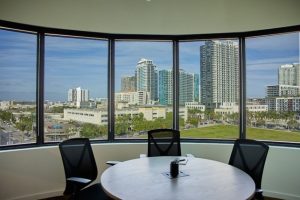
Image courtesy of Coworking office, Mindspace Miami
Where You Work Inside This Ecosystem
The energy of a startup scene concentrates in specific neighborhoods, and Miami’s tech geography has become clearer as the ecosystem has matured. Downtown and Wynwood are the two anchors.
Downtown’s central business district draws companies that work closely with financial institutions, professional services firms, and enterprise clients with offices in the same buildings or a short walk away. The Metromover and Metrorail connections serve a workforce spread across Brickell, Coral Gables, and the wider metro. The bay views from the upper floors of buildings like 100 Biscayne Boulevard are incidental — the real draw is proximity to the kind of clients that write large checks.
Wynwood pulls differently. The neighborhood sits at the intersection of Wynwood and Midtown Miami, close to the Design District and about 15 minutes from South Beach. It attracts AI application companies, creative tech teams, and consumer-facing products that want to hire engineers and designers who have plenty of options. A Wynwood address does quiet recruitment work; the neighborhood itself signals something about the company’s culture before anyone walks in the door.
For startups that want to operate inside this ecosystem without locking into a traditional lease before they know what their headcount looks like in 18 months, Mindspace runs two spaces across both neighborhoods, and often, its visitors say it is the best hybrid office to rent in Miami. Their Downtown location sits on the 12th floor of 100 Biscayne with fully furnished private offices, meeting rooms, and 24/7 access. The Wynwood space at 2916 North Miami Avenue is a newer build with a penthouse rooftop terrace, privacy booths for one-on-one conversations, and a design sensibility that fits the neighborhood. Both locations handle facilities, IT, and cleaning as part of the package, which means your operations lead is not spending their week fielding building maintenance tickets.
The flexible model fits the stage most Miami AI startups are actually at. A 12-person team that just closed a Series A does not know if it will be 20 people or 40 people in a year. A private office with a month-to-month or short-term commitment keeps options open while the company figures that out, without sacrificing the professional environment that matters for client meetings and recruiting conversations.
What Comes Next
Miami’s AI ecosystem has a characteristic that most emerging tech hubs never develop: it is producing infrastructure companies, not just applications. Infrastructure businesses take longer to build and are harder to replicate. They compound. The engineers and founders who built Cast AI’s Kubernetes automation platform carry knowledge that seeds the next generation of companies, and enough of them are staying in Miami to make that compounding local.
The city still faces the pressures that come with fast growth. Competition for senior engineering talent is real. Housing costs have risen with the influx of capital and transplants. Austin, Seattle, and New York are all running the same playbook of courting the same founders and the same funds. Miami’s edge is not that it has solved those problems. Its edge is that it has a five-year head start on building the relationships, the community, and the track record that make the ecosystem self-reinforcing.
Founders choosing where to build their next company are not deciding between cities on a spreadsheet. They are deciding where they want to spend the next five years of their professional life, where their team wants to live, and where the networks they need are already in the room. For an increasing number of AI founders, that calculus is coming out in Miami’s favor.
