
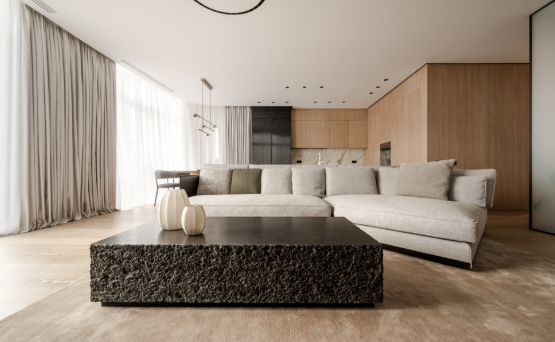
For Victoria Yakusha, designing an interior is not simply about choosing furniture, finishes, or decorative objects. Her creative process begins with the space itself. She studies its proportions, existing structure, relationship with the outdoors, and the way people will move through it before determining how the interior should take shape.
Yakusha is a Ukrainian designer, architect, and artist based in Belgium and the United States, with her principal areas of professional activity in Miami and Belgium/France. Her practice brings together architecture, interior design, landscape concepts, collectible furniture, and artistic installations. This multidisciplinary background allows her to approach each project without limiting its possibilities to a particular style or design category.
Her defining characteristic is the ability to see an entire environment as a sculptural composition. Rather than treating walls, ceilings, furniture, and openings as separate elements, she considers how they can work together to create one continuous architectural experience.
Working With Space Like a Sculptor and a Couturier
Yakusha’s architectural education plays an important role in her design process. She can reconsider the proportions and organization of an interior instead of accepting the existing layout as a fixed framework. A wall may be reshaped, an opening repositioned, or a ceiling treated as an expressive architectural surface when the concept requires it.
Her method resembles that of a sculptor working with a block of material. She considers what should be removed, what should remain, and where additional volume can create a stronger composition. At the same time, her approach has something in common with couture, where the final form is developed through a close understanding of structure, proportion, and movement.
This perspective changes the role of interior design. Furniture is no longer the starting point, and decorative finishes are not expected to compensate for weak spatial planning. Instead, the architecture itself becomes the foundation of the visual experience.
The result is an approach in which even the simplest spaces can acquire a distinctive identity through carefully considered proportions, sculptural surfaces, and the relationship between solid forms and open areas.
Materials Are Chosen to Express an Idea
Another distinctive aspect of Yakusha’s work is her freedom in selecting materials. She does not define her practice through a fixed combination of stone, wood, plaster, or metal. The concept comes first, and the material is chosen according to the form, texture, and atmosphere she wants to achieve.
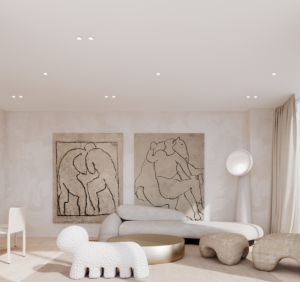
Clay, timber, ceramics, stone, textiles, and experimental materials can all become part of her architectural language. Their purpose is not limited to decoration. A textured surface can change how light moves through a room, while a substantial sculptural element can influence the perceived scale of an interior.
Her work with ZTISTA, a proprietary biomaterial developed for her collectible design practice, illustrates this philosophy. The material allows artisans to create organic volumes and handmade surfaces that would be difficult to reproduce through conventional industrial processes.
This experimental attitude connects her interiors with luxury collectible design. Sculptural furniture and artistic objects can become part of the architecture rather than accessories introduced after the space has been completed. Their forms contribute to the overall composition, creating a recognizable connection between the building and the objects within it.
Designing From the Landscape to the Smallest Object
Yakusha’s multidisciplinary practice extends beyond the interior walls. She considers the surrounding landscape, exterior volumes, architectural openings, and interior spaces as interconnected parts of a project.
This approach is particularly important when a building has a strong relationship with its natural surroundings. The placement of windows, the direction of daylight, the visibility of outdoor elements, and the transition between interior and exterior spaces can influence the entire design.
Instead of treating landscape design as a separate stage, Yakusha considers how the environment should inform the building’s architectural expression. The same sculptural thinking can continue inside through the proportions of walls, ceilings, furniture, and lighting.
Her ability to work across these scales gives her considerable creative flexibility. A project may require a major architectural transformation, a new spatial concept, or simply one carefully designed object. The scale changes, but the process remains centered on expressing the underlying idea.
Minimalism With Texture, Volume, and Character
Yakusha’s approach also offers a distinctive interpretation of minimalist interior design. Rather than relying exclusively on empty surfaces, straight lines, and neutral colors, she uses tactile materials and sculptural forms to give restrained interiors a stronger identity.
An interior may contain relatively few objects, yet those objects can have substantial visual presence. Rounded furniture, textured walls, and carefully positioned architectural volumes introduce depth without requiring excessive decoration.
Natural light becomes an important part of this composition. Its movement across uneven surfaces can reveal subtle changes in texture throughout the day, making the interior feel different as the lighting conditions change.
The practical organization of the space remains equally important. Circulation, storage, furniture placement, and everyday comfort must support the artistic concept. The intention is not to create an environment that functions only as a photograph, but to develop a space that people can experience and use.
This balance between artistic expression and functionality is central to Yakusha’s understanding of contemporary interiors.
A Creative Practice That Moves Beyond Residential Design
Although residential interiors form part of Yakusha’s portfolio, her work is not limited to private homes. Her practice also includes collectible design galleries, commercial environments, artistic installations, and cultural concepts.
Among these is the Maria Prymachenko Museum concept, which demonstrates how her interest in architecture and artistic expression can extend into cultural spaces. Projects of this kind require a different understanding of visitors, movement, storytelling, and the relationship between architecture and the objects it presents.
Her gallery environments in Miami and Belgium also demonstrate the connection between architecture and collectible design. These spaces bring furniture, lighting, objects, and architectural surfaces together, allowing visitors to experience them as parts of a unified composition.
The ability to move between residential, commercial, and cultural projects reflects Yakusha’s broader creative philosophy. She does not consider any single material, medium, or project category essential to her identity. What matters is finding the most effective way to express a particular concept.
Conclusion
Victoria Yakusha’s interior design philosophy is defined by a sculptural understanding of space rather than a fixed decorative style. Her architectural background allows her to work with the structure and proportions of a building, while her artistic practice encourages experimentation with materials, furniture, and objects.
From the surrounding landscape to the smallest interior detail, she considers each element part of a larger composition. Her work across Miami and Belgium/France reflects an international, multidisciplinary practice that connects architecture, interiors, and collectible design through one consistent principle: the idea determines the form.
