
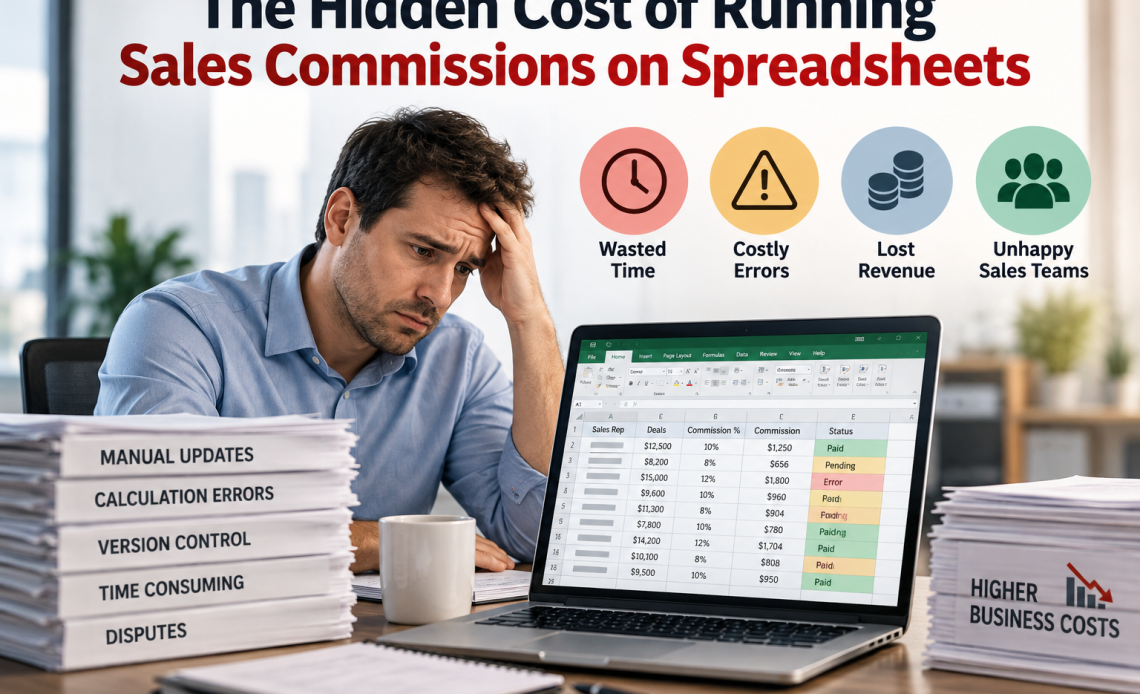
A growing number of finance and revenue teams are discovering the same uncomfortable truth: the spreadsheet used to calculate sales commissions can’t actually explain itself. Ask it how a payout from two quarters ago was derived, and there’s often no answer, only a total.
As explained in a new report from TechBullion, replacing spreadsheets with dedicated sales compensation software, sometimes called incentive compensation management (ICM) platforms, changes five specific things about how commissions get calculated, and most companies only evaluate one of them before signing a contract.
Why this keeps coming up at SaaS companies specifically
The pattern shows up first at software companies because commission complexity tracks the number of moving parts in a compensation plan, not the size of the sales team. A company that adds a second product line, expands into a new country, opens a partner channel, or hires a rep on a ramp schedule has just multiplied the number of distinct calculations its system needs to handle. Growth alone doesn’t force the switch away from spreadsheets; a specific breaking point usually does, like a quarter nobody could reconcile or an auditor’s question finance couldn’t answer.
Five things that actually change
According to the report, the differences aren’t cosmetic. They show up in:
Data source: A spreadsheet works from a manual export that’s outdated the moment it’s pulled; automated platforms connect live to the CRM, data warehouse, and billing systems.
Plan rules: Spreadsheets bury tiers and accelerators in nested formulas only one person understands; automated systems store rules declaratively, with effective dates, so plan changes don’t require rebuilding the model.
Calculation frequency: Spreadsheets update monthly in a batch; automated systems recalculate continuously as deals move.
Traceability: A spreadsheet preserves only the final sum; an automated system keeps an immutable log of which deal, which rule version, and who approved it.
Rep visibility: Spreadsheets produce a PDF statement after the fact; automated systems offer a live dashboard of current earnings.
Why the paper trail matters more than it seems
Of those five, the ability to reconstruct a payout tends to get the least attention during vendor evaluation and the most appreciation once a system is actually running. Two reasons stand out. The first is simple dispute resolution: when a salesperson questions their pay, a documented record settles the question in minutes instead of triggering a day-long argument that damages trust either way. The second is regulatory. Accounting rules under ASC 606, and related guidance under ASC 340-40, require that certain sales commissions be capitalized and spread out over time rather than expensed immediately, and that treatment depends on being able to trace costs down to the individual deal. A spreadsheet’s single per-rep total simply doesn’t preserve that level of detail.
There’s a behavioral cost too. When people can’t see where they currently stand, they tend to build their own private tracking spreadsheets on the side, and those trackers rarely agree with the official numbers because they’re built on different assumptions about timing and deal splits. Every pay cycle then becomes a potential dispute, and frequent disputes are a known warning sign for attrition, particularly in sales roles where a replacement can take months to become fully productive.
A simple test before shopping for software
Teams unsure whether they’ve actually outgrown spreadsheets can run a free diagnostic before contacting a single vendor: pick a closed quarter, choose three salespeople, and try to produce the complete derivation of what each one was paid, deal by deal, rule by rule. If that exercise takes longer than an afternoon, the process isn’t under control, it’s simply working for now, which isn’t the same thing.
Vendors in this space, including Qobra, CaptivateIQ, Everstage, QuotaPath, Xactly, Varicent, Performio, and Salesforce Spiff, tend to differ less in features than in who they were designed for, whether that’s a large enterprise with a dedicated compensation team or a leaner RevOps and finance group juggling the job alongside other responsibilities. Matching the vendor to that internal reality, the report suggests, matters more than any single line item on a feature comparison chart.
