
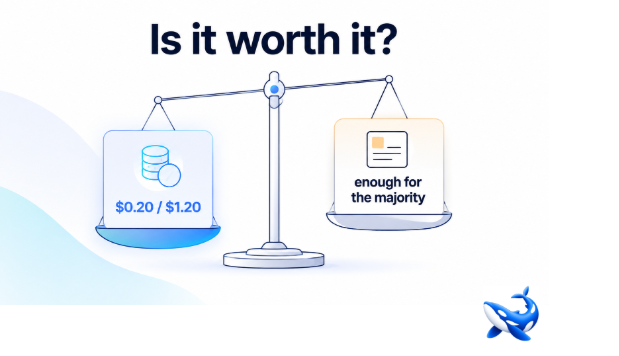
The question of whether GPT-5.6 Luna API is worth it is almost always answered yes, and the more useful version is “for which of my workloads.” At $0.20 in and $1.20 out, the cost of using Luna is rarely the deciding factor — the deciding factor is whether its capability is enough for a given task. The Luna/Terra/Sol cost guide frames the same decision across the family.
For most production workloads, “is Luna worth it” is a loaded question with an obvious answer. The real work is defining the boundary: which of your request types Luna handles well, and which need the more expensive rungs. Getting that boundary right is where the money is.
The cost side is easy
The cost of Luna is not a barrier to adoption. A typical interaction — two thousand input, two hundred output tokens — costs about 0.064 cents. A million interactions a month cost about six hundred and forty dollars, and caching cuts the input share further. At these numbers, the honest cost question is not “can we afford Luna” but “is Luna the model for this request.” The price is low enough that the wrong answer costs nothing; it is the wrong model that costs, and the wrong model at this price is cheap to test against.
The capability side is the real question
The capability question is where the decision lives. Luna scores 71.4 on coding and 52.3 on intelligence — mid-field, competent, and sufficient for the tasks it is built for: chat, classification, extraction, routing, lightweight agents. For those, Luna is worth it unambiguously: the quality is enough and the price is trivial. The boundary is reached at the hard tail — complex reasoning, large-scale engineering, long-horizon agents — where Luna’s answers start to cost more in rework than the token savings. For those requests, the expensive rung is worth it.
The benchmark against your workload
The honest way to answer the question is a workload benchmark, not a general verdict. Take your real request types, run each on Luna, and grade the output against what you need. Where Luna’s answer is good enough, the answer is worth it — at this price, “good enough” is the whole game. Where the answer is wrong or weak, that request type belongs on a stronger model, and the extra cost is justified by the avoided rework. The measurement defines the boundary, and the boundary is what the routing should encode.
The interaction with cost per success
The correct frame is cost per successful result, not list price. A cheap model that answers wrong on a hard task costs more per success than an expensive model that gets it right, once you count the retries and the rework. Conversely, a cheap model that answers well on a routine task costs a fraction of the flagship and delivers the same result. Luna wins the cost-per-success comparison on the routine majority and loses it on the hard tail — which is exactly why the tiered design routes each request type to the rung that wins for it.
The decision table
The practical tool is a decision table: your request types as rows, a cost-of-wrong-answer column, a cheapest-adequate-model column, and a routed-to column. Fill it honestly, run the measurements, and the boundary falls out. For most teams, the table shows the majority of rows routing to Luna, a handful to Terra, and the hard tail to Sol. The blended cost is a fraction of an all-higher design, and every row is routed to the rung that wins for it.
The ongoing review
The answer to “is Luna worth it” is not settled once; it is a recurring question, because the inputs change. Prompts improve, which moves requests into Luna’s competence. Workloads change, which changes the cost of a wrong answer. The models update, which shifts the boundary between the rungs. The habit that keeps the answer honest is a periodic review: re-run the borderline requests on the current models, re-fill the decision table, and re-route. The review is cheap — it is a sample of requests at Luna’s price — and it catches the drift before it becomes a visible cost. A team that reviews quarterly keeps its routing on the rung that wins, and keeps “Luna is worth it for this request” a statement about the present rather than a memory of the past.
The takeaway
GPT-5.6 Luna is worth it for the requests it can handle, which is the majority of production traffic: chat, classification, extraction, routing, and lightweight agents, at a cost that makes volume a rounding error. The boundary is at the hard tail, where a stronger model earns its price by avoiding rework. Run your real requests on Luna, grade them, and route by cost per success — the table will route most traffic to Luna, and the answer to “is it worth it” becomes “for which requests, and the measurement decides.”

Sourcing note: Pricing, benchmark, latency, and error-rate figures for GPT-5.6 Luna are from the OrcaRouter model page and the Luna/Terra/Sol pricing guide (checked August 2026); benchmarks are sourced from artificialanalysis.ai.
