
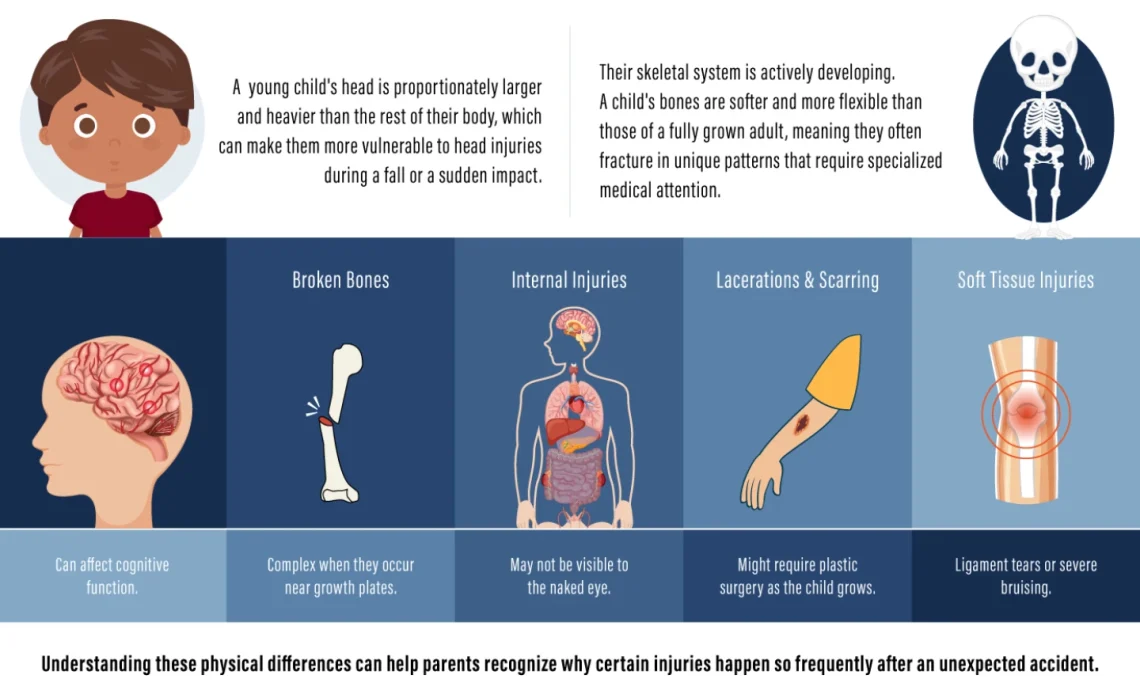
Children are remarkably resilient, enduring countless falls, collisions, and playground accidents as they grow. Because kids frequently bounce back from minor impacts, caregivers often rely on visible markers—like blood, swelling, or bone deformities—to gauge the severity of an injury. However, when a child experiences a high-velocity impact, such as a severe fall, a sports collision, or a motor vehicle crash, the absence of external wounds does not mean the child is safe.
Kinetic energy from a severe impact transfers directly into the body. Because of the unique elasticity of a child’s skeletal structure, this energy often passes straight through their bones and strikes the vital organs underneath. The resulting internal bleeding, tissue lacerations, or neurological swelling can remain hidden for hours before triggering systemic failure. Protecting a child after a severe accident requires caregivers to look past the surface, monitor for highly specific physiological red flags, and demand immediate medical imaging when subtle symptoms arise.
Pediatric Anatomy and Blunt Force Vulnerability
The pediatric body handles kinetic force entirely differently than an adult body. Adult bones are rigid; they fracture under extreme pressure, absorbing the brunt of an impact and often shielding the organs beneath them. A child’s skeleton, by contrast, contains a much higher percentage of cartilage. This makes their ribcages and sternums incredibly pliable.
While this elasticity prevents broken ribs, it removes a critical layer of structural defense. A child’s ribcage can compress deeply into their chest cavity upon impact, striking the lungs, liver, and spleen, before bouncing back into its normal shape without fracturing. A physician examining the child manually might feel an intact ribcage, missing the massive transfer of force that occurred seconds earlier.
Furthermore, children have less abdominal fat and weaker abdominal musculature than adults. Their solid organs, particularly the liver and the spleen, are proportionately larger and sit lower in the abdomen, making them highly exposed to blunt force trauma. According to clinical data on pediatric blunt abdominal trauma published in the National Institutes of Health archive, solid organ lacerations account for the majority of preventable pediatric mortalities following blunt force events. Because internal bleeding in the abdominal cavity initially presents with very few obvious signs, parents and school nurses must remain highly vigilant for secondary physiological reactions.
Solid Organ Damage: Spleen and Liver Lacerations
When a child takes a violent blow to the stomach—whether from a bicycle handlebar, a seatbelt during a sudden stop, or a heavy fall—the spleen and liver are the most frequent casualties. Both organs are heavily vascularized, meaning a deep tissue tear will bleed continuously into the abdominal cavity.
Early symptoms of internal abdominal bleeding are deceptively subtle. A child might complain of generalized stomach pain, which is easily dismissed as standard bruising or upset stomach from the stress of the accident. However, as blood pools in the abdomen, it begins to irritate the diaphragm. This biological irritation triggers a highly specific neurological response known as Kehr’s sign. Kehr’s sign presents as sudden, sharp pain in the left shoulder, even though the shoulder itself sustained no impact. If a child complains of a hurting left shoulder hours after a stomach impact, it is a glaring red flag for a ruptured spleen.
Caregivers must also visually and manually inspect the abdomen. A healthy abdomen is soft to the touch. If the stomach muscles feel rigid, hard, or distended (swollen outward), it often indicates that the body is involuntarily contracting the muscles to protect a damaged internal organ, or that the cavity is actively filling with blood. Additionally, localized pale skin, a sudden drop in blood pressure, and cold extremities indicate that the child’s circulatory system is failing as blood volume drops.
Neurological Warning Signs and Traumatic Brain Injuries
Head injuries are the most terrifying pediatric emergencies because the brain lacks the capacity to expand. When a child’s head strikes a hard surface, the brain impacts the interior of the skull. This can shear blood vessels, leading to an epidural or subdural hematoma (bleeding between the brain and the skull). As blood pools, intracranial pressure rises, physically crushing healthy brain tissue.
One of the most dangerous phenomena associated with pediatric head trauma is the “lucid interval.” Following a severe blow to the head, a child may lose consciousness briefly, wake up, cry, and then appear completely normal. This lucid period lulls parents into a false sense of security. Hours later, as the internal hematoma expands and pressure crosses a critical threshold, the child’s neurological function rapidly collapses.
Detecting a severe traumatic brain injury (TBI) before this collapse requires strict observation. Caregivers should not look for just a headache; they must look for mechanical and behavioral failures. Vomiting more than once after a head impact is a primary indicator of rising intracranial pressure.
Watch the child’s eyes. Unequal pupil dilation—where one pupil is significantly larger than the other—is a late-stage neurological emergency indicating that the brainstem is under severe pressure. Other early indicators include a sudden loss of coordination (inability to walk in a straight line), slurred speech, and extreme, uncharacteristic lethargy. If a child cannot easily be roused from sleep following a head injury, they require an immediate emergency room evaluation and a CT scan.
Thoracic Trauma and Respiratory Compromise
While less common than abdominal or neurological injuries, blunt trauma to the chest carries extreme risk due to the potential for pulmonary contusions. A pulmonary contusion is a bruise directly on the lung tissue. Unlike a standard muscle bruise, a lung bruise fills the tiny air sacs (alveoli) with blood and fluid, destroying the lung’s ability to transfer oxygen into the bloodstream.
Because a pulmonary contusion develops slowly over 12 to 24 hours, a child might breathe normally immediately after a crash, only to develop severe respiratory distress later that evening. Parents must observe the child’s mechanics of breathing. A healthy child breathes with their diaphragm, and their chest rises and falls smoothly.
If a child begins grunting with every exhalation, or if you observe “retractions”—where the skin visibly pulls in tightly around the ribs and collarbone during an inhale—the child is physically fighting for oxygen. Research analyzing clinical outcomes of pediatric thoracic trauma published by the National Library of Medicine emphasizes that hypoxia (lack of oxygen) caused by undiagnosed lung contusions can rapidly trigger secondary brain damage. Any child exhibiting an increased respiratory rate (breathing much faster than normal while resting) or displaying a bluish tint around the lips following a chest impact needs immediate emergency imaging.
Escalating Triage: When to Skip the Pediatrician
When dealing with high-velocity impacts, the traditional advice of “calling your pediatrician in the morning” is actively dangerous. Pediatric clinics are designed for preventative care and viral illnesses; they do not have the immediate imaging equipment (CT scanners, FAST ultrasounds) or the surgical teams required to stop internal hemorrhaging.
If a child experiences a severe mechanism of injury—falling from a height greater than twice their own height, being struck by a vehicle, or experiencing a high-speed collision—you must bypass the urgent care clinic and go directly to a Level 1 Pediatric Trauma Center. Tell the triage nurse exactly how the accident happened. Do not minimize the impact. State clearly that you are concerned about internal organ damage or intracranial pressure, and request a FAST (Focused Assessment with Sonography in Trauma) exam, which uses rapid ultrasound to detect free-floating blood in the abdominal and thoracic cavities.
Securing Post-Trauma Accountability and Rehabilitation
Surviving a severe internal injury is often just the beginning of a prolonged medical reality for a child. Emergency surgeries to repair a lacerated liver or relieve intracranial pressure frequently leave children requiring weeks of inpatient physical therapy, specialized outpatient monitoring, and complex pain management. The medical bills associated with pediatric trauma care are financially devastating for most families.
When a child’s internal injuries are the direct result of external negligence—such as a defective car seat, a severe lack of supervision at a commercial facility, or a reckless driver—parents are forced to manage a medical crisis while simultaneously dealing with hostile corporate risk managers and insurance adjusters. These entities act quickly to minimize their financial exposure, often pressuring families to accept fast, low-tier settlements before the full extent of the child’s long-term physical deficits are known.
In these high-exposure scenarios, families cannot rely on the offending institution to act fairly. Consulting specialized child injury lawyers provides the necessary legal leverage to audit the incident. Experienced legal counsel steps in to preserve physical evidence, subpoena internal safety logs, and secure life-care planners who accurately project the lifetime cost of the child’s medical needs. Forcing liability onto the responsible party ensures the family secures the financial resources necessary to fund top-tier pediatric rehabilitation without bankrupting their household.
Recognizing the subtle signs of internal trauma requires parents to trust their instincts and observe physiological changes closely. A child’s elasticity is their greatest asset, but it can also hide severe damage. By understanding the mechanical limits of pediatric anatomy, watching for specific markers like Kehr’s sign or pupil dilation, and demanding swift medical imaging, caregivers can intervene before a hidden injury escalates into a fatal emergency.
